
Types of Hairlines: Straight, Widow's Peak, Receding, Rounded, Uneven and Bell-Shaped

Hairlines vary widely in shape and position. This guide explains the six common types of hairlines, how male and female patterns differ, and how to distinguish a naturally maturing hairline from one that is receding.
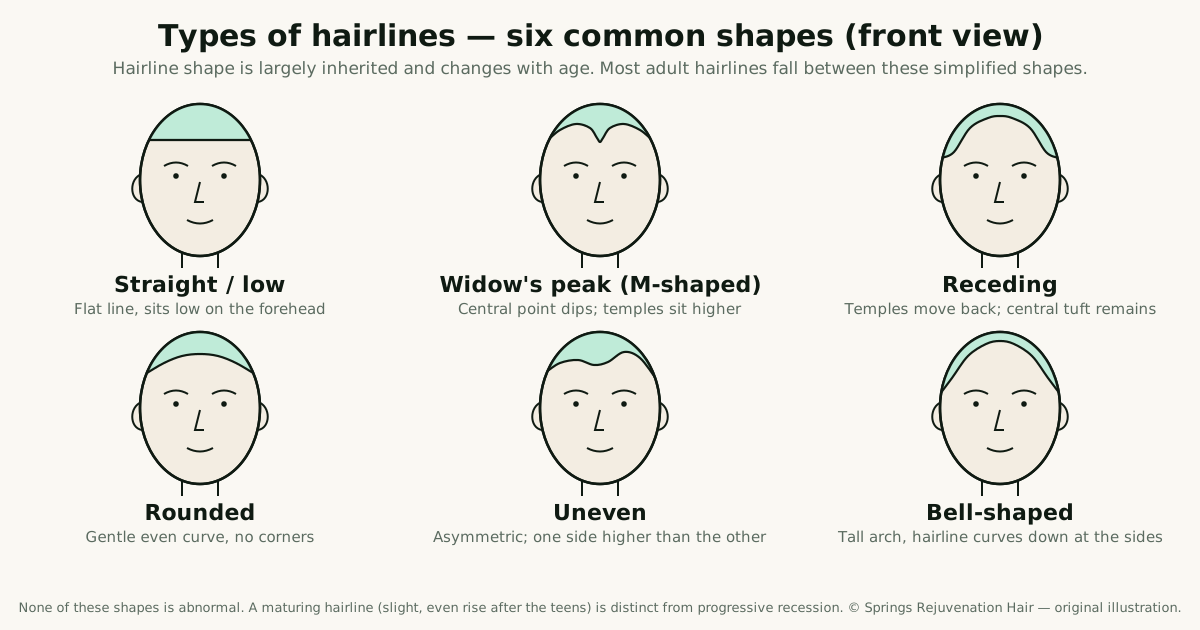
The hairline—the border where scalp hair meets forehead skin—shows remarkable variation across individuals. A hairline that appears unusual to one person may fall well within the spectrum observed in large photographic studies. Yet many men and women worry whether their hairline shape or position signals impending hair loss, particularly when they notice features such as a pronounced widow's peak, asymmetry, or a high forehead.
This page reviews the anatomy of the hairline, describes the six types of hairlines commonly seen in clinical practice, explains how male and female hairlines differ, and outlines how physicians distinguish a naturally maturing hairline from one that is receding. The information draws from peer-reviewed dermatology and hair-restoration literature and is intended to help readers understand what falls within normal variation and what warrants evaluation.
What is a hairline, and what makes one 'normal'?
The frontal hairline is the anterior border of scalp hair, typically running from one temple to the other across the forehead. The temporal points mark the hairline's position at each side of the head, just above the temples. The region between the frontal hairline and the temporal points on each side is sometimes called the hairline 'corners' or fronto-temporal recessions.
Normal hairlines demonstrate wide variation in height, shape, and symmetry. A hairline positioned several centimeters above the highest forehead crease may be an individual's baseline from childhood, while another person's hairline may sit close to the brow. Some hairlines form a nearly straight horizontal line; others dip into a central point or sweep in a gentle arc. The International Society of Hair Restoration Surgery notes that hairline patterns are inherited traits and that variability is the norm rather than the exception.
There is no single template for a 'good' or 'healthy' hairline. What matters clinically is whether the hairline position and density are stable over time or whether progressive change—particularly thinning at the border and deepening of the temporal recessions—is occurring.
The six common types of hairlines (with diagram)
Clinicians and researchers have described several recurring hairline patterns. The following table summarizes six types of hairlines, what each looks like, and whether the pattern itself signals hair loss.
| Hairline type | What it looks like | Is it a sign of hair loss? |
|---|---|---|
| Straight (low) | Runs nearly horizontal across the forehead with minimal central dip or temporal recession | No, if stable. A straight hairline that remains unchanged is a normal variant. |
| Widow's peak | Forms a distinct V-shaped or M-shaped pattern with a central point projecting downward toward the nose | No. A widow's peak present since adolescence is an inherited feature, not a marker of hair loss. |
| Rounded (oval) | Sweeps in a smooth, convex arc from temple to temple without sharp angles | No, if position and density are stable. Rounded hairlines are common in women and in men with low to moderate temporal points. |
| Receding | Temporal points have moved upward and backward, often asymmetrically; the central forelock may remain lower, creating an M or U shape | Yes, when the pattern progresses beyond the mature hairline position (see below). Corresponds to Norwood stages II and higher (Norwood, 1975). |
| Uneven (asymmetric) | One side of the hairline sits higher or deeper than the other; the temporal recession may be more pronounced on the left or right | It depends. Mild asymmetry is common and not a concern if stable. Progressive deepening on one side suggests androgenetic hair loss. |
| Bell-shaped | The central portion of the hairline is higher than the sides, forming an inverted-U or bell contour | No, if it has been present since youth. Some individuals inherit a naturally high central hairline with lower temporal points. |
Individuals often describe their hairline as 'weird' when it does not match an imagined ideal. In most cases, these hairlines are simply normal anatomic variants. The American Academy of Dermatology emphasizes that hair-loss evaluation should focus on change over time rather than on whether a hairline matches a particular aesthetic standard.
Male vs female hairlines
Male and female hairlines differ in typical shape and the likelihood of androgenetic change. In a photographic study of naturally occurring female hairlines, Nusbaum and Fuentefria (2009) documented that the majority of women exhibit a rounded or oval frontal hairline. The authors found that widow's peak–type patterns—including both a central downward point and variations they termed 'lateral mounds' where the hairline dips on each side of center—were present in approximately 81 percent of the female volunteers. Female hairlines also tend to maintain a relatively horizontal or gently arched contour across the temples, with less pronounced temporal recession than is typical in men.
Male hairlines more often feature defined temporal points and, over time, commonly undergo maturation (described in the next section) or progression to androgenetic patterns classified by the Norwood scale. Even among men who do not experience significant hair loss, the hairline typically sits higher and shows more angulation at the temples than the average female hairline.
These are population-level observations; individual variation is considerable. Some women have naturally high or angular hairlines, and some men retain low, rounded hairlines into middle age. DermNet notes that female-pattern hair loss, when it occurs, usually preserves the frontal hairline while thinning the crown and mid-scalp, in contrast to the frontal and temporal recession seen in male-pattern hair loss.
Mature hairline vs receding hairline: how to tell the difference
One of the most common sources of confusion is distinguishing a mature hairline—a normal developmental change—from a receding hairline that signals androgenetic alopecia (male-pattern hair loss). Rassman, Pak, and Kim (2013) studied the phenotype of normal hairline maturation in men and found that most males experience an upward shift of the hairline of approximately one to one-and-a-half centimeters (roughly the width of one finger) between the late teenage years and the late twenties. This shift occurs even in men who will not go on to develop significant baldness.
The key features of a mature hairline are that it rises evenly, maintains a rounded or gently arched shape, and stops progressing once the maturation period is complete. The temples may move upward slightly, but the hairline remains symmetric and does not deepen into pronounced M-shaped recessions. Rassman and colleagues described this as a transition from a juvenile (low, straight) hairline to an adult position.
A receding hairline, by contrast, continues to move backward beyond the mature position. The temporal recessions deepen, often asymmetrically, and the pattern corresponds to Norwood stage II or higher on the male-pattern hair-loss scale (Norwood, 1975). The hairline may take on a distinct M or U shape as the central forelock remains while the sides thin. In some men, the entire hairline moves steadily upward and backward over months to years.
Individuals who are uncertain whether their hairline is maturing or receding may benefit from serial photographs taken in consistent lighting at intervals of six to twelve months. Comparing images can reveal whether the position is stable or shifting.
Signs a hairline is receding (and what is not a sign)
Several findings suggest that a hairline is receding rather than simply occupying a stable, genetically determined position:
- Progressive change. Comparison of photographs over time shows the hairline moving upward or the temples deepening. Change is the hallmark of active hair loss.
- Miniaturized hairs at the border. The frontal edge of a receding hairline often contains fine, short, barely pigmented hairs (miniaturized or 'vellus-like' hairs). Under magnification or in bright light, these hairs appear thin and lack the diameter of terminal scalp hair. Miniaturization is a histologic signature of androgenetic alopecia.
- Asymmetric temple deepening. One temporal recession becomes noticeably deeper than the other, or one side thins faster. While mild asymmetry is normal, progressive unilateral deepening often indicates androgenetic change.
- Increased shedding along the hairline. Some individuals notice more hairs on the pillow or in the shower corresponding to the frontal and temporal zones. This is not a universal finding, but when present alongside the changes above, it supports the diagnosis.
The following are not reliable signs of recession:
- A high forehead that has been present since childhood. If serial photographs (school pictures, for example) show the same hairline position over many years, that is the individual's baseline, not hair loss.
- A symmetric widow's peak. A V-shaped hairline unchanged since adolescence is an inherited feature.
- Visible scalp between hairs. Some individuals have fine or blonde hair that reveals more scalp even when density is normal. Scalp visibility alone, without progressive thinning, does not indicate hair loss.
- Concern triggered by a single photograph. Lighting, camera angle, and hairstyle can dramatically alter how a hairline appears in photos. Clinical evaluation and serial imaging are more informative than a single image.
The American Academy of Dermatology recommends that anyone noticing progressive thinning or a changing hairline consult a dermatologist or hair-restoration physician. Early evaluation allows for discussion of medications (finasteride, minoxidil, dutasteride) that may slow or halt further change.
How surgeons design a hairline when restoration is considered
When medication alone does not meet a patient's goals, or when significant recession has already occurred, some individuals explore surgical hair restoration. The design of a new hairline is a nuanced process that balances aesthetics, donor supply, and long-term planning. Shapiro and Shapiro (2013) outlined several principles that hair-restoration surgeons consider during hairline design:
- Micro-irregularity. A natural hairline is not a straight line. Surgeons create slight irregularities and angles along the border to mimic the randomness seen in non-transplanted hairlines. Hairlines that are too geometric can appear unnatural.
- Single-hair grafts at the frontal edge. The first few millimeters of the hairline are populated with follicular units containing one hair each. This 'feathered' transition prevents an abrupt, pluggy appearance. Larger grafts (two- to four-hair units) are placed behind the frontal edge to build density.
- Age-appropriate height. A hairline positioned too low may look incongruous as a patient ages and surrounding areas continue to thin. Surgeons typically place the new hairline at or slightly above the mature position to ensure a natural result over decades.
- Respect for the temporal points. The hairline must connect smoothly to the temporal points. Overly aggressive lowering of the temples can appear unusual and may require more donor hair than is available.
Before any surgical procedure is discussed, most surgeons will address whether medication (finasteride, minoxidil, or dutasteride) should be used to stabilize the existing hairline and prevent further loss behind the transplanted zone. Medications do not regrow substantially lost hair, but in published series they can maintain density in areas that are thinning but not yet depleted. Individual responses vary, and not all patients are candidates for or willing to use these medications.
Dr. Charles Pereyra, a board-certified emergency physician and member of the International Society of Hair Restoration Surgery, performs micrograft follicular-unit-excision (FUE) procedures and conducts the hairline design himself during the consultation, termed a Follicular Health Assessment. The consultation reviews the patient's hair-loss pattern, donor scalp characteristics, medical history, and goals. No outcome is assured; the suitability of any intervention depends on individual factors that can only be determined through examination.
Final considerations
Hairline variation is the rule in human populations. Straight, widow's peak, rounded, bell-shaped, and even mildly uneven hairlines are all observed in individuals who will never experience significant hair loss. The distinction between a stable, inherited hairline and one that is receding lies in documented change over time, the presence of miniaturized hairs, and deepening temporal recessions. Rassman and colleagues (2013) demonstrated that a mature hairline—rising one to one-and-a-half centimeters in early adulthood—is a normal developmental event, not hair loss. Beyond that point, progression signals androgenetic alopecia and warrants evaluation.
For those considering intervention, understanding the principles of hairline design and the role of medication in halting progression can inform decision-making. Springs Rejuvenation offers Follicular Health Assessments in Miami, Los Angeles, Austin, Atlanta, and New York. Individuals with questions about their hairline or hair-loss pattern may call (888) 503-4482 to arrange a consultation with Dr. Pereyra.
Medical disclaimer: Stem cell and exosome therapy is not an FDA approved therapy and is considered to be in the experimental stages; it is not FDA approved to treat any disease. These statements have not been evaluated by the FDA and are not intended to diagnose, treat, cure, or prevent any disease. Individual results may vary. This page is educational and is not medical advice; always consult a qualified physician. Written and reviewed for medical accuracy by Dr. Charles Pereyra, MD, Medical Director, Springs Rejuvenation Hair.
Frequently asked questions
What does a normal hairline look like?
Normal hairlines vary widely in shape and position. Some form a nearly straight line across the forehead, while others sweep in a rounded arc or dip into a widow's peak. The hairline may sit close to the eyebrows or several centimeters higher. Photographic studies show that what appears 'normal' spans a broad range. A hairline is considered normal if it has been stable over time, shows no progressive thinning, and contains terminal (thick, pigmented) hairs along the border rather than miniaturized, fine hairs. Individual responses vary, and inherited patterns differ across populations.
Is a widow's peak a sign of balding?
A widow's peak that has been present since adolescence is an inherited feature, not a sign of balding. In a study of naturally occurring female hairlines, Nusbaum and Fuentefria (2009) found that approximately 81 percent of women exhibited some form of widow's peak or lateral mound pattern. The key distinction is stability: a widow's peak that remains unchanged in position and density over years is simply a normal variant. Progressive deepening of the temporal recessions on either side of the peak, accompanied by miniaturized hairs, may signal androgenetic hair loss and warrants evaluation.
How do I know if my hairline is receding or maturing?
Rassman and colleagues (2013) found that most men experience a mature hairline shift of one to one-and-a-half centimeters upward between the late teens and late twenties, even when significant balding will not occur. A mature hairline rises evenly, maintains a rounded or gently arched shape, and then stops moving. A receding hairline continues beyond that point, often with deepening temporal recessions and miniaturized hairs at the border. Serial photographs taken six to twelve months apart, in consistent lighting, can reveal whether the position is stable or shifting. Progressive change is the hallmark of recession.
Can a hairline be restored with a hair transplant?
Hair transplantation, when performed by a qualified surgeon, can relocate follicles from a stable donor zone to areas of thinning or recession. Shapiro and Shapiro (2013) describe design principles such as micro-irregularity, single-hair grafts at the frontal edge, and age-appropriate positioning. Individual results depend on donor-hair characteristics, the extent of recession, and post-procedure care. Medication (finasteride, minoxidil, or dutasteride) is often discussed to help maintain hair behind the transplanted zone, as transplantation does not halt the underlying process of androgenetic hair loss. No procedure assures a specific outcome; suitability must be determined through examination.
Do women get receding hairlines?
Yes, though female-pattern hair loss typically presents differently from male-pattern recession. DermNet notes that women often experience diffuse thinning over the crown and mid-scalp while the frontal hairline is relatively preserved. However, some women do notice widening of the central part or subtle recession at the temples. Nusbaum and Fuentefria (2009) documented the range of naturally occurring female hairlines, showing that variation is common. Progressive thinning, miniaturized hairs, or a changing hairline position warrants evaluation by a dermatologist or hair-restoration physician. Early assessment allows discussion of medications and other options.
Sources
- Rassman WR, Pak JP, Kim J. Phenotype of normal hairline maturation. Facial Plast Surg Clin North Am. 2013
- Nusbaum BP, Fuentefria S. Naturally occurring female hairline patterns. Dermatol Surg. 2009
- Shapiro R, Shapiro P. Hairline design and frontal hairline restoration. Facial Plast Surg Clin North Am. 2013
- Norwood OT. Male pattern baldness: classification and incidence. South Med J. 1975
- American Academy of Dermatology — What is male pattern hair loss, and can it be treated?
- International Society of Hair Restoration Surgery — What is hair loss?
- DermNet — Male pattern hair loss
I am honestly shocked at how much hair I grew back. The doctor said 6 to 12 months. Its be 4 and my hair is completely different. SUPER HAPPY!
I literally had no results for 4 months, and I started to worry. I must have called every day. Thanks for your patience, haha. I'm about 8 months in, and I'm seeing incredible progress.
Reviews are individual patient experiences shared publicly on Google. Individual responses vary.
Ready to Reclaim Your Confidence? Book Your Free Hair Loss Consultation
No pressure, no obligation — just an honest assessment of your hair loss, your candidacy, and your options from a board-certified physician.
Individual results vary. Stem cell and exosome therapies are not FDA-approved to treat any disease. This site is for informational purposes and is not medical advice. Individual responses vary. Stem cell and exosome therapies are investigational and not FDA approved to treat any disease.