
The Norwood Scale: Stages of Male Pattern Hair Loss Explained

The Norwood scale is the most widely used classification for male pattern hair loss, mapping seven progressive stages from a full hairline to extensive balding. Understanding your stage helps guide decisions.
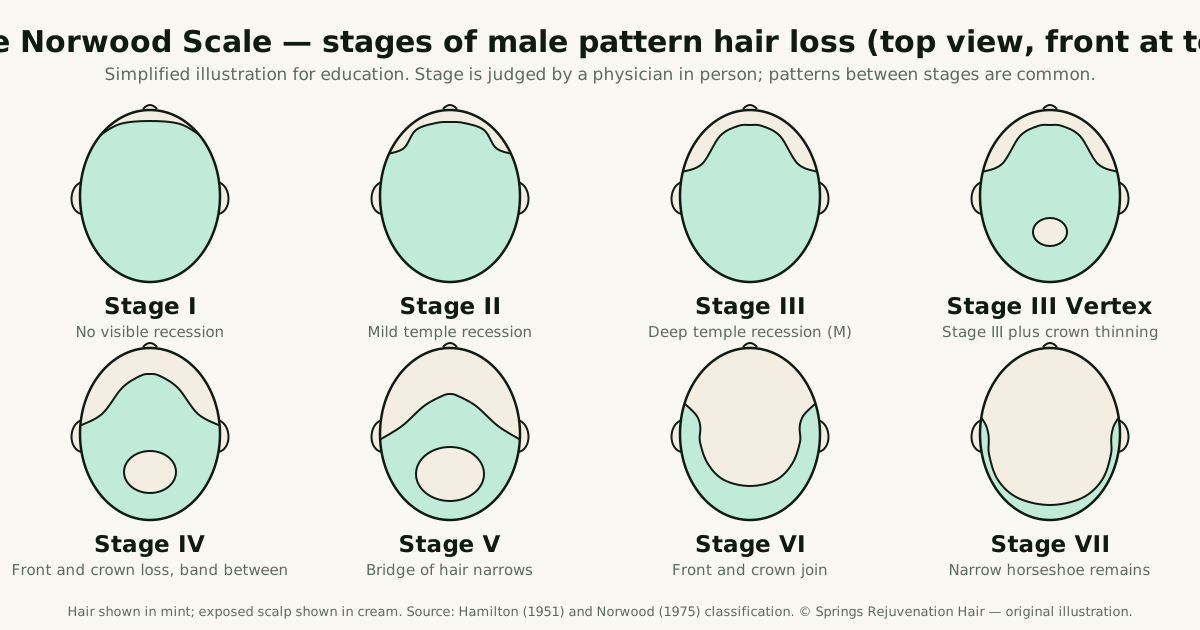
The Norwood scale is the most widely used classification system for male pattern hair loss. Developed by dermatologist Dr. James Hamilton in 1951 and refined by Dr. O'Tar Norwood in 1975, the scale maps the progression of androgenetic alopecia—hair loss driven by genetic sensitivity to androgens—into seven distinct stages, from a full juvenile hairline to extensive balding that leaves only a horseshoe-shaped fringe. Norwood studied 1,000 men to establish the patterns and frequency of each stage, creating a shared vocabulary that physicians, researchers, and individuals use to describe the extent and location of hair loss.
The scale does not diagnose the cause of hair loss; rather, it standardizes the description of pattern and severity. Many men notice some degree of hairline change as they age. In a study by Rhodes and colleagues published in 1998, 42 percent of men aged 18 to 49 showed moderate to extensive hair loss, and Norwood's original work documented that incidence rises steadily with age. Recognizing which stage most closely fits an individual's pattern can inform conversations about medications, procedural options, and realistic expectations.
What is the Norwood scale?
The Norwood scale—formally the Hamilton-Norwood scale—is a visual grading system that physicians use to classify the extent of male pattern baldness. Hamilton first described the progression in 1951, identifying stages based on hairline recession and crown thinning. In 1975, Norwood expanded Hamilton's work by studying a larger cohort of 1,000 men, refining the stages and adding what are now called Type A variants, which follow a different progression pattern. The resulting framework divides male pattern hair loss into seven primary stages (I through VII) and several intermediate or variant stages (IIa, IIIa, IIIv, IVa, Va).
The purpose of the scale is descriptive, not diagnostic. Androgenetic alopecia has a well-understood mechanism: genetically susceptible hair follicles miniaturize when exposed to dihydrotestosterone (DHT), a derivative of testosterone. Over time, terminal hairs—thick, pigmented strands—shrink into fine vellus hairs and eventually stop growing altogether. The Norwood scale captures where and how extensively this miniaturization has occurred at a given point in time. It does not predict how quickly progression will occur, nor does it capture diffuse thinning patterns or hair loss in women, who are graded on the separate Ludwig scale (Gupta and Mysore, 2016).
Physicians value the scale because it provides a reproducible shorthand. A Norwood Stage III carries specific implications for donor hair availability and graft planning that differ markedly from a Stage VI. Researchers use the stages to stratify participants in clinical trials of medications or procedural techniques. Individuals use the scale to understand where they stand and what changes to watch for. The American Academy of Dermatology and the StatPearls monograph on androgenetic alopecia (Ho et al., 2024) both reference the Norwood classification as the standard for male pattern hair loss assessment.
The seven Norwood stages, explained
Each Norwood stage reflects a progressive increase in hair loss, typically starting at the temples and crown and advancing until only the occipital and parietal zones—the sides and back of the scalp—retain terminal hair. The following descriptions are based on Norwood's 1975 publication and subsequent reviews (Gupta and Mysore, 2016; MedlinePlus, 2024).
Stage I represents a full juvenile hairline with no recession. Most adolescents and young adults begin here. There is no thinning at the temples or crown, and the hairline sits low on the forehead. Stage I is uncommon in men over 30, as normal maturation of the hairline—described by Rassman and colleagues in 2013—typically occurs between the late teens and early twenties.
Stage II shows symmetric, triangular recession at the frontotemporal angles. The hairline pulls back slightly at the temples, creating small triangular patches of bare scalp. The central forelock remains intact, and there is no crown thinning. Many men in their twenties and thirties exhibit Stage II recession. Norwood noted that this pattern, while technically a change from the juvenile baseline, is often cosmetically minor and may not progress further for years or at all.
Stage III marks the threshold Norwood considered cosmetically significant baldness. The frontotemporal recession deepens, and the triangular bald patches extend farther back along the hairline. In some individuals, a small area of thinning appears at the vertex—the crown—creating what Norwood labeled Stage III vertex (or IIIv). At Stage III, the frontal and vertex zones remain separated by a band of hair. Rhodes and colleagues found that the prevalence of Stage III and higher increased sharply with age, affecting the majority of men by their fifties.
Stage IV involves more extensive frontal recession and enlargement of the vertex bald spot. The two areas of loss—frontal and crown—are still separated by a bridge of moderately dense hair that stretches across the top of the scalp. The horseshoe-shaped occipital and parietal fringe remains full. Stage IV represents a clear progression in the amount of scalp visible and often prompts individuals to seek evaluation.
Stage V shows the bridge of hair between the frontal and vertex zones narrowing. The separation persists, but the band is sparser and thinner than in Stage IV. The overall area of hair loss is greater, and the remaining hair on top of the scalp may appear wispy. The donor zone—hair along the back and sides—remains stable, as these follicles typically resist DHT-mediated miniaturization.
Stage VI is characterized by the loss of the bridge that separated the frontal and crown areas. The two bald zones merge, leaving a continuous expanse of bare scalp across the top and front of the head. Hair persists only as a horseshoe-shaped fringe running from temple to temple around the back of the scalp. The remaining hair may still be relatively dense in the donor zone.
Stage VII represents the most extensive form of male pattern baldness. Only a narrow band of hair remains, confined to the lower occipital and parietal regions. The horseshoe fringe is sparse, and the width of the remaining donor zone is reduced. Norwood observed that Stage VII is relatively uncommon and typically occurs in older men with a long history of progressive hair loss.
Norwood stages at a glance
The table below summarizes the hallmarks of each stage, condensing the descriptions into a quick reference. Individual variation exists; not every man will follow this exact sequence, and progression rates differ widely.
| Stage | Hairline | Crown | What people usually notice |
|---|---|---|---|
| I | Full, juvenile; no recession | No thinning | Minimal or no visible change |
| II | Symmetric triangular recession at temples | No thinning | Slight temple recession, often subtle |
| III | Deeper frontotemporal recession; bare triangular patches | May show thinning (IIIv) | Visible hairline change; possible crown thinning |
| IV | Extensive frontal recession | Expanding bald spot; separated by hair bridge | Clear frontal and crown loss; bridge of hair on top |
| V | Frontal zone larger | Vertex zone larger; narrow bridge remains | Thinning bridge; greater area of scalp visible |
| VI | Merged with crown zone | Merged with frontal zone; bridge gone | Continuous baldness on top; horseshoe fringe only |
| VII | Extensive bare scalp | Extensive bare scalp | Narrow, sparse horseshoe of hair at back and sides |
Physicians may also note intermediate stages—such as between II and III or IV and V—if the pattern does not fit neatly into a single category. The scale is a guide, not a rigid checklist, and inter-rater variability has been documented in published studies (Gupta and Mysore, 2016).
Norwood 1 vs Norwood 2: mature hairline or early recession?
One of the most common questions men ask is whether the hairline change they notice represents normal maturation or the start of pattern baldness. Rassman and colleagues described the phenotype of normal hairline maturation in a 2013 review: most men experience a subtle upward shift of the hairline—typically one to two centimeters—during their late teens or early twenties. This maturation creates a more angular, adult contour and is not considered pathological hair loss.
Norwood Stage I reflects the unreceded juvenile hairline. Stage II shows symmetric, triangular recession at the temples that extends beyond what maturation alone would produce. The distinction can be subtle. A mature hairline usually remains relatively straight across the central forelock, with gentle rounding at the corners. A Norwood II hairline exhibits more pronounced triangular recessions, sometimes called temporal peaks or widow's peaks, and the hairline sits higher on the temples than a mature but stable configuration would suggest.
Importantly, not all men with a Norwood II hairline will progress to advanced stages. Norwood noted that a substantial proportion of men remain at Stage II for years or indefinitely. Individual genetic factors, family history, and age at onset influence progression. If the pattern remains stable over several years, it may represent a mature hairline rather than active androgenetic alopecia. Conversely, if recession continues and deepens into Stage III, the process is more likely progressive. Physicians often recommend observation over six to twelve months, and medications such as finasteride or minoxidil may be discussed if progression is documented and the individual wishes to slow further change (American Academy of Dermatology; Ho et al., 2024).
The Type A variants and other patterns the scale misses
Norwood identified a subset of men whose hair loss follows a different trajectory, which he called Type A variants. In the Type A pattern, recession proceeds from front to back without forming a separate island of thinning at the crown. The stages are labeled IIa, IIIa, IVa, and Va. A man with a Norwood IIa pattern shows slight frontal recession but maintains hair density across the mid-scalp and crown. As the pattern advances to IIIa, the frontal hairline moves farther back, but the vertex remains covered. By Stage IVa, the frontal recession is extensive, yet there is still no distinct crown bald spot; instead, the entire top of the scalp thins more uniformly. Stage Va shows further anterior progression.
The Type A variants are less common than the classic patterns, but they are important to recognize because the progression and the aesthetic appearance differ. A Norwood IVa individual may have a larger bald area at the front than a classic Stage IV, yet the intact crown may preserve a different overall contour. Physicians take this into account when estimating the number of grafts that might be needed in a restoration procedure.
The Norwood scale also has limitations. It does not capture diffuse thinning—a pattern in which hair density decreases uniformly across the scalp without distinct frontal or vertex zones. Diffuse thinning is more common in women, who are graded on the Ludwig scale, but it can occur in men as well. The Norwood classification also shows inter-rater variability; two observers may assign slightly different stages to the same individual. Finally, the scale is a snapshot in time and does not predict rate of progression. A man at Stage III may remain stable for a decade, while another may advance to Stage VI in a few years. Genetic background, androgen levels, and possibly other metabolic or environmental factors influence the trajectory (Ho et al., 2024; MedlinePlus, 2024).
How physicians use the Norwood stage to plan hair restoration
The Norwood stage is a starting point in any conversation about hair restoration. Dr. Pereyra, a board-certified emergency physician and member of the International Society of Hair Restoration Surgery, grades the pattern during a Follicular Health Assessment to establish a baseline and discuss what procedural or medical options might be appropriate. The stage informs several key planning variables: the surface area that would need coverage, the density goal, and the availability of donor hair.
Men at early stages—Norwood II or III—may have limited recession and ample donor reserves. If they wish to address the hairline, a relatively small number of follicular unit grafts may suffice to reframe the frontal zone. Physicians may also discuss whether medications such as finasteride (a 5-alpha-reductase inhibitor that reduces DHT) or minoxidil (a topical vasodilator) could slow progression, allowing a procedural intervention to be deferred or minimized. Individual responses to these medications vary, and neither is universally effective (American Academy of Dermatology; Ho et al., 2024).
Men at intermediate stages—Norwood IV or V—present a larger recipient area and a narrowing bridge of existing hair. Restoring a natural appearance in these cases often requires more grafts and careful attention to hairline design, transition zones, and crown coverage. The donor-to-recipient ratio becomes a central consideration: the occipital and parietal zones contain a finite number of follicles that can be harvested without leaving visible depletion. Physicians estimate graft requirements based on the area to be covered, the desired density (typically measured in follicular units per square centimeter), and the quality of the donor hair (caliber, curl, color contrast with the scalp).
Advanced stages—Norwood VI and VII—pose the greatest challenge. The area of baldness is extensive, and the donor supply is limited. In some cases, the available grafts may be insufficient to achieve full, dense coverage across the entire bald zone. Physicians may prioritize the frontal hairline and mid-scalp, accepting lower density in the crown, or recommend staged procedures spread over time. Expectations must be realistic; while modern follicular unit extraction (FUE) and follicular unit transplantation (FUT) techniques can produce natural-looking results, they cannot create hair where the donor supply is exhausted. Honest discussions about density, coverage limits, and the likelihood of needing future sessions are part of ethical planning (Gupta and Mysore, 2016).
The Norwood stage also helps physicians counsel individuals about progression. A young man at Stage III may be advised that further loss is possible and that maintaining existing hair with medication could preserve more donor reserves for future procedures. An older man at Stage VI with a stable pattern for years may be a candidate for a single, comprehensive procedure. There is no one-size-fits-all answer; each person's goals, age, rate of progression, and donor capacity shape the plan.
Springs Rejuvenation Hair offers Follicular Health Assessments at clinics in Miami (Aventura), Los Angeles, Austin, Atlanta, and New York. During an assessment, Dr. Pereyra examines the scalp, grades the Norwood stage, reviews medical history, and discusses what options align with the individual's goals. Those interested in learning more may call (888) 503-4482 to schedule a consultation.
Medical disclaimer: Stem cell and exosome therapy is not an FDA approved therapy and is considered to be in the experimental stages; it is not FDA approved to treat any disease. These statements have not been evaluated by the FDA and are not intended to diagnose, treat, cure, or prevent any disease. Individual results may vary. This page is educational and is not medical advice; always consult a qualified physician. Written and reviewed for medical accuracy by Dr. Charles Pereyra, MD, Medical Director, Springs Rejuvenation Hair.
Frequently asked questions
What Norwood stage is considered balding?
Norwood himself identified Stage III as the threshold for cosmetically significant balding. At this stage, frontotemporal recession is deep enough to create visible triangular bare patches, and some individuals also show thinning at the crown (Stage III vertex). Stages II and below often represent normal hairline maturation or minimal recession that many men live with without concern. Stages IV through VII reflect progressively larger areas of hair loss and are unambiguously classified as advanced androgenetic alopecia. Individual perception varies; what one person considers significant, another may not.
Is a Norwood 2 hairline receding or just mature?
A Norwood II hairline shows symmetric, triangular recession at the temples that goes beyond the subtle upward shift typical of normal maturation. A mature hairline usually remains relatively straight across the central forelock with gentle rounding at the corners, whereas a Norwood II exhibits more pronounced triangular peaks. Not all men with Stage II progress further; some remain stable for years. If the hairline does not deepen over six to twelve months of observation, it may represent a mature configuration rather than active androgenetic alopecia. Family history and age at onset can provide additional context.
Can you stop hair loss at Norwood 3?
Medications such as finasteride and minoxidil have been studied for their ability to slow progression of androgenetic alopecia, and some individuals experience stabilization or modest regrowth. Finasteride reduces dihydrotestosterone (DHT) levels, while minoxidil may prolong the growth phase of hair follicles. Individual responses vary; not everyone achieves the same degree of stabilization, and neither medication reverses advanced miniaturization. Early intervention is generally associated with greater likelihood of preserving existing hair. Physicians typically recommend ongoing use, as discontinuation often leads to resumption of hair loss. No intervention assures complete cessation of progression.
At what Norwood stage can you get a hair transplant?
Hair restoration procedures can be performed at any Norwood stage, but the feasibility and outcome depend on donor supply, recipient area, and goals. Men at Stages II or III often have ample donor hair and limited recipient areas, making restoration straightforward. Stages IV and V require more grafts and careful planning to balance hairline, mid-scalp, and crown coverage. Stages VI and VII present the greatest challenge due to extensive baldness and finite donor reserves; full, dense coverage may not be achievable, and realistic expectations are essential. Physicians assess each case individually, considering age, rate of progression, and donor quality.
Does the Norwood scale apply to women?
The Norwood scale was developed specifically for male pattern hair loss and does not accurately capture the typical progression of androgenetic alopecia in women. Women more commonly experience diffuse thinning across the top of the scalp while preserving the frontal hairline, a pattern described by the Ludwig scale, which classifies thinning into three grades. Some women may show frontotemporal recession similar to men, and in those cases, physicians may reference Norwood stages, but the Ludwig classification is the standard tool for female androgenetic alopecia. Diagnosis and grading should be tailored to the observed pattern.
Sources
- Norwood OT. Male pattern baldness: classification and incidence. South Med J. 1975
- Hamilton JB. Patterned loss of hair in man: types and incidence. Ann N Y Acad Sci. 1951
- Gupta M, Mysore V. Classifications of patterned hair loss: a review. J Cutan Aesthet Surg. 2016
- Rhodes T et al. Prevalence of male pattern hair loss in 18-49 year old men. Dermatol Surg. 1998
- Rassman WR, Pak JP, Kim J. Phenotype of normal hairline maturation. Facial Plast Surg Clin North Am. 2013
- American Academy of Dermatology — What is male pattern hair loss, and can it be treated?
- Ho CH, Sood T, Zito PM. Androgenetic Alopecia. StatPearls (NCBI Bookshelf). 2024
- MedlinePlus Medical Encyclopedia (NIH) — Male pattern baldness
I am honestly shocked at how much hair I grew back. The doctor said 6 to 12 months. Its be 4 and my hair is completely different. SUPER HAPPY!
I literally had no results for 4 months, and I started to worry. I must have called every day. Thanks for your patience, haha. I'm about 8 months in, and I'm seeing incredible progress.
Reviews are individual patient experiences shared publicly on Google. Individual responses vary.
Ready to Reclaim Your Confidence? Book Your Free Hair Loss Consultation
No pressure, no obligation — just an honest assessment of your hair loss, your candidacy, and your options from a board-certified physician.
Individual results vary. Stem cell and exosome therapies are not FDA-approved to treat any disease. This site is for informational purposes and is not medical advice. Individual responses vary. Stem cell and exosome therapies are investigational and not FDA approved to treat any disease.