
The Ludwig Scale: Grades of Female Pattern Hair Loss Explained

The Ludwig scale classifies female pattern hair loss into three grades based on the width of the midline part while the frontal hairline typically remains intact, helping physicians diagnose diffuse thinning.
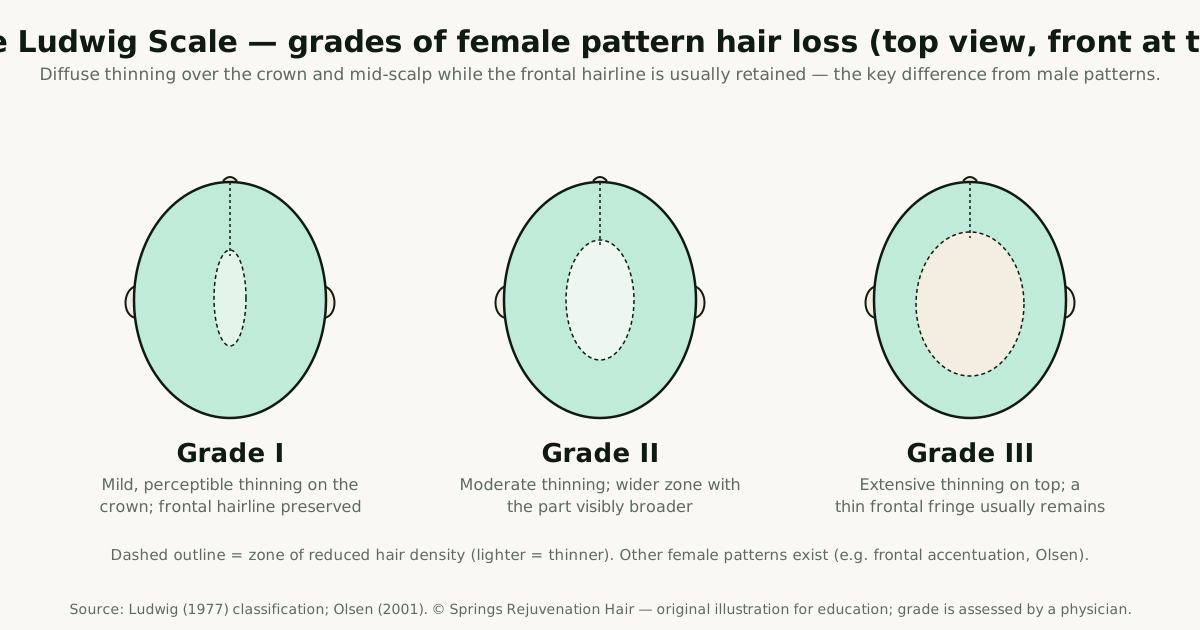
When women notice their part getting wider or their ponytail feeling thinner, the pattern of hair loss is usually quite different from the receding temples and bald crown familiar in men. In 1977, dermatologist E. Ludwig published a classification system that captured what most women with pattern hair loss actually experience: diffuse thinning across the crown and midline while the frontal hairline remains largely in place (Ludwig, 1977). The Ludwig scale remains the most widely used grading system for female pattern hair loss today.
Understanding where someone falls on the Ludwig scale helps physicians distinguish genetic thinning from other causes and guides decisions about labs, medications, and whether a hair restoration procedure might be an option. This article explains the three Ludwig grades, contrasts them with male pattern loss, reviews other classification systems, and outlines the diagnostic steps a physician takes before recommending any therapy.
What is the Ludwig scale?
The Ludwig scale divides female pattern hair loss into three grades based on the degree of thinning over the central scalp. Unlike male pattern hair loss, which typically starts at the temples and vertex, women with Ludwig-type hair loss develop progressive miniaturization of hair follicles in the frontal and parietal regions while maintaining a band of denser hair along the very front of the hairline. This frontal fringe often stays intact even in advanced stages, which is why a woman's hairline may look normal from the front while the part appears dramatically wider (Herskovitz & Tosti, 2013).
The scale is simple: Grade I shows perceptible thinning on the crown; Grade II shows pronounced thinning; and Grade III shows diffuse, near-complete hair loss over the entire top of the scalp with the frontal hairline still preserved. The American Academy of Dermatology notes that female pattern hair loss becomes more common with age, affecting roughly 40 percent of women by age 50, though individual responses to hormonal and genetic factors vary widely.
Ludwig grades I, II and III (with diagram)
Each Ludwig grade reflects increasing follicular miniaturization visible along the midline part. The table below summarizes what a physician looks for at each stage:
| Grade | What the part looks like | Frontal hairline | Typical concern |
|---|---|---|---|
| I | Part is slightly wider; scalp is faintly visible through thinning hair | Intact | Ponytail feels less full; parting hair reveals more scalp than before |
| II | Part is noticeably wider; significant scalp show-through; fewer hairs per area | Intact | Difficulty styling to cover the part; volume loss across the crown |
| III | Extensive thinning or near-total hair loss over the crown and top; scalp clearly visible | Intact or minimally affected | Limited coverage options; wig or hair system often considered |
It is important to recognize that progression is not inevitable; some women remain at Grade I for years, while others advance more rapidly depending on hormonal changes, genetic factors, and whether any therapy is initiated. Early studies suggest that topical minoxidil may slow progression in some cases, though individual responses vary (MedlinePlus, NIH).
Why female pattern hair loss looks different from male pattern loss
The Norwood-Hamilton scale, which classifies male pattern hair loss, tracks bitemporal recession and vertex balding. Men typically lose hair in a horseshoe pattern, with deep temporal recessions forming an "M" shape and a bald spot developing at the crown. Women rarely show that pattern. Instead, female pattern hair loss is characterized by diffuse thinning over the top of the scalp while the frontal hairline stays relatively intact (Olsen, 2001).
This difference has practical implications. A man with advanced Norwood-stage hair loss usually has a stable, dense donor zone at the back and sides of the scalp, which makes him a straightforward candidate for follicular unit excision if he chooses a hair restoration procedure. A woman with Ludwig-type thinning, on the other hand, may have miniaturization throughout the scalp, including the occipital donor area. That means candidacy for a hair transplant must be assessed on a case-by-case basis; a stable, dense donor zone is the key factor, and not all women with pattern hair loss will have one.
Hormonal and genetic drivers also differ. While androgens play a role in both sexes, the threshold and receptor sensitivity vary. Women with female pattern hair loss do not always have elevated androgen levels; in many cases, normal circulating androgens interact with genetically susceptible follicles. The American Academy of Dermatology points out that thyroid dysfunction, iron deficiency, and other metabolic factors can also contribute to or mimic pattern hair loss in women, which is why a thorough workup is needed.
Other classification systems: Olsen's 'Christmas tree' pattern and Sinclair
Not all women fit neatly into the Ludwig framework. In 2001, dermatologist Elise Olsen described a variant in which thinning is most pronounced at the frontal scalp and gradually tapers toward the crown, forming a triangular or "Christmas tree" distribution when viewed from above (Olsen, 2001). Women with this pattern may notice hair loss at the front of the head more than over the crown, which can make the part look wider near the hairline even though the Ludwig scale traditionally emphasizes mid-scalp thinning.
The Sinclair scale, developed in Australia, uses standardized photographs of the midline part to grade female pattern hair loss from 1 (minimal) to 5 (advanced). Sinclair and colleagues collected prevalence data in the town of Maryborough and found that female pattern hair loss is common and increases with age, affecting roughly 6 percent of women under 30, rising to more than 40 percent by age 70 (Gan & Sinclair, 2005). The Sinclair scale is particularly useful in clinical trials because the photographic reference images allow for consistent grading across examiners.
In practice, a physician may use the Ludwig scale for its simplicity and then note whether the patient shows a Christmas-tree pattern or other variation. The choice of classification does not change the underlying biology, but it can help communicate the distribution of thinning and set realistic expectations for how hair restoration procedures or medical therapies might help.
What else causes thinning in women (and why it changes the plan)
A widening part is not always female pattern hair loss. Several other conditions produce diffuse thinning, and distinguishing them is essential because the approach differs. Telogen effluvium is a reactive shedding that occurs two to three months after a triggering event such as childbirth, rapid weight loss, high fever, surgery, or severe emotional stress (Hughes et al., 2024). Hair enters the resting phase prematurely and then falls out in large numbers. Telogen effluvium is usually temporary; once the trigger resolves, regrowth begins within months, though recovery can take a year or more.
Iron deficiency and thyroid disorders are common metabolic causes of hair thinning in women. Ferritin levels below 40 ng/mL are often associated with increased shedding, even when anemia is not present. Hypothyroidism and hyperthyroidism can both disrupt the hair cycle. Correcting the underlying deficiency or hormone imbalance often allows hair to recover, which is why laboratory testing is a standard part of the evaluation.
Traction alopecia results from chronic pulling on the hair, typically from tight ponytails, braids, or hair extensions. It usually affects the frontal and temporal hairline first, creating a pattern distinct from Ludwig-type thinning. If the traction is stopped early, regrowth is possible; if it continues for years, lasting follicular damage can occur.
Frontal fibrosing alopecia is a scarring (cicatricial) form of hair loss that primarily affects the frontal hairline and eyebrows. It is most common in postmenopausal women and is thought to be a variant of lichen planopilaris. Scalp biopsy may be needed to confirm the diagnosis. Because the follicles are destroyed by inflammation and replaced with scar tissue, hair restoration procedures are usually not advised in areas of active scarring disease, though therapy with topical or systemic anti-inflammatory agents may slow progression (DermNet).
The key point is that diffuse thinning has many possible causes, and the correct therapy depends on the diagnosis. A woman with telogen effluvium does not need minoxidil; she needs reassurance and time. A woman with frontal fibrosing alopecia may need a dermatologist's help managing inflammation before any cosmetic procedure is considered. This is why a careful history, scalp examination, and selective laboratory testing come first.
How a physician evaluates female hair loss before recommending anything
A thorough evaluation begins with the patient's history. How long has the thinning been noticeable? Was there a recent illness, pregnancy, medication change, or period of high stress? Is there a family history of hair loss? Does the scalp itch, burn, or show scaling? The answers help narrow the differential diagnosis.
On examination, the physician assesses the pattern and density of hair loss, checks for scalp inflammation or scarring, and evaluates the frontal hairline and part width. A hair pull test, in which a small tuft of hair is gently tugged, can help distinguish active shedding (telogen effluvium) from stable miniaturization (pattern hair loss). Dermoscopy, a magnified view of the scalp, may reveal follicular miniaturization, hair-shaft diameter variation, or signs of inflammation.
Laboratory tests are ordered selectively based on clinical suspicion. A complete blood count, ferritin, thyroid-stimulating hormone, and sometimes a comprehensive metabolic panel are common starting points. In women with signs of hyperandrogenism—irregular menses, acne, hirsutism—total and free testosterone, dehydroepiandrosterone sulfate, and prolactin may be measured. Scalp biopsy is reserved for cases in which the diagnosis is uncertain or a scarring alopecia is suspected.
If the diagnosis is female pattern hair loss, the physician discusses medical and procedural options. Topical minoxidil is the only medication FDA approved for female pattern hair loss and is available in 2% and 5% formulations; responses vary, and it can take four to six months to see any effect (MedlinePlus, NIH). Anti-androgen medications such as spironolactone are used off-label in some cases, particularly in women with hyperandrogenism, though the evidence is mixed and individual responses vary. Finasteride is not FDA approved for female pattern hair loss and is contraindicated in women who are or may become pregnant because of the risk of birth defects in male fetuses. Neither progesterone supplementation nor spironolactone has a consistent, documented benefit for all women with pattern hair loss; therapy must be individualized.
For women considering a hair restoration procedure, donor-zone assessment is critical. A follicular unit excision procedure transplants hair from the back and sides of the scalp to thinning areas. If the donor zone itself shows miniaturization—common in diffuse Ludwig-type hair loss—the number of grafts available may be limited, and results may be less robust than in men with a stable horseshoe donor pattern. Candidacy is determined case by case, and realistic expectations are essential.
Dr. Charles Pereyra, a board-certified emergency physician and member of the International Society of Hair Restoration Surgery, evaluates women with hair thinning at Springs Rejuvenation Hair clinics in Miami, Los Angeles, Austin, Atlanta, and New York. A Follicular Health Assessment includes a detailed history, scalp examination, and discussion of medical and procedural options tailored to the individual's diagnosis and goals. Those interested may call (888) 503-4482 to schedule a consultation.
Medical disclaimer: Stem cell and exosome therapy is not an FDA approved therapy and is considered to be in the experimental stages; it is not FDA approved to treat any disease. These statements have not been evaluated by the FDA and are not intended to diagnose, treat, cure, or prevent any disease. Individual results may vary. This page is educational and is not medical advice; always consult a qualified physician. Written and reviewed for medical accuracy by Dr. Charles Pereyra, MD, Medical Director, Springs Rejuvenation Hair.
Frequently asked questions
What is Ludwig grade 2 hair loss?
Ludwig grade 2 hair loss is characterized by pronounced thinning over the crown and midline part, with noticeable scalp show-through and reduced hair density across the top of the scalp. The frontal hairline typically remains intact. Women at this stage often find it difficult to style their hair in a way that conceals the widened part and may notice significant volume loss. Individual responses to therapy vary, and progression is not inevitable; some women remain stable at grade 2 for years.
Does female pattern hair loss ever affect the hairline?
Classic Ludwig-type female pattern hair loss usually preserves the frontal hairline, leaving a band of denser hair along the forehead even as the crown and midline thin. However, some women show a variant pattern described by Olsen in 2001, in which thinning is most pronounced at the frontal scalp, creating a Christmas-tree distribution. In those cases, the hairline may appear to recede or thin. A physician can distinguish this variant from other causes such as traction alopecia or frontal fibrosing alopecia.
Can women with Ludwig scale hair loss get a hair transplant?
Candidacy for a hair restoration procedure depends on the density and stability of the donor zone at the back and sides of the scalp. Women with diffuse Ludwig-type thinning may have miniaturization throughout the scalp, including the donor area, which can limit the number of grafts available and affect outcomes. A thorough evaluation, including scalp examination and donor assessment, is necessary. Some women are excellent candidates; others are not. Realistic expectations and individualized planning are essential.
Is a widening part always female pattern hair loss?
No. Diffuse thinning can result from telogen effluvium (shedding after illness, childbirth, or stress), iron deficiency, thyroid disorders, traction alopecia, or scarring conditions such as frontal fibrosing alopecia. A careful history, scalp examination, and selective laboratory testing are needed to distinguish female pattern hair loss from these other causes. The correct diagnosis determines the therapy; for example, a woman with iron deficiency may see regrowth once ferritin is corrected, while someone with pattern hair loss may benefit from topical minoxidil.
Which medications are FDA approved for female pattern hair loss?
Topical minoxidil is the only medication FDA approved for female pattern hair loss. It is available in 2% and 5% formulations and individual responses vary; it can take four to six months to see any effect. Anti-androgens such as spironolactone are used off-label in some women, particularly those with hyperandrogenism, though evidence is mixed. Finasteride is not FDA approved for female pattern hair loss and is contraindicated in women who are or may become pregnant.
Sources
- Ludwig E. Classification of the types of androgenetic alopecia occurring in the female sex. Br J Dermatol. 1977
- Olsen EA. Female pattern hair loss. J Am Acad Dermatol. 2001
- Herskovitz I, Tosti A. Female pattern hair loss. Int J Endocrinol Metab. 2013
- Gan DC, Sinclair RD. Prevalence of male and female pattern hair loss in Maryborough. J Investig Dermatol Symp Proc. 2005
- American Academy of Dermatology — Thinning hair and hair loss: could it be female pattern hair loss?
- DermNet — Female pattern hair loss
- MedlinePlus (NIH) — Minoxidil topical drug information
- Hughes EC, Syed HA, Saleh D. Telogen Effluvium. StatPearls (NCBI Bookshelf). 2024
I am honestly shocked at how much hair I grew back. The doctor said 6 to 12 months. Its be 4 and my hair is completely different. SUPER HAPPY!
I literally had no results for 4 months, and I started to worry. I must have called every day. Thanks for your patience, haha. I'm about 8 months in, and I'm seeing incredible progress.
Reviews are individual patient experiences shared publicly on Google. Individual responses vary.
Ready to Reclaim Your Confidence? Book Your Free Hair Loss Consultation
No pressure, no obligation — just an honest assessment of your hair loss, your candidacy, and your options from a board-certified physician.
Individual results vary. Stem cell and exosome therapies are not FDA-approved to treat any disease. This site is for informational purposes and is not medical advice. Individual responses vary. Stem cell and exosome therapies are investigational and not FDA approved to treat any disease.